Source-headline guide · 11 cited facts · 1 source hosts
Single source: theguardian.com — not independently corroborated.
Ghent's £17m design museum absorbs CO2 and is built from old sinks, windscreens and toilets
Answer and evidence scope
- Answer
- The Guardian reports that Ghent's new £17m design museum is built from recycled construction waste, including 62,000 bricks that continue to absorb CO2 as the lime cures. [1] [2] [3] [4] [5] [6] [7] [8] [9] [10] [11]
- Significance
- The listed evidence does not establish broader implications.[1] [2] [3] [4] [5] [6] [7] [8] [9] [10] [11]
- Uncertainty
- Source-headline guide · 11 cited facts · 1 source hosts — Source claims do not establish independent corroboration.
What happened
Ghent's new £17m design museum has opened as a recycling showcase, built from condemned concrete frames, windows, car windscreens, sinks and old toilets, the Guardian reports (theguardian. com). The building rises above the Belgian city's medieval tiled rooftops and was designed by London-based Carmody Groarke with local firms Atama and Re-st. Architect Andy Groarke said "There's nothing new about reuse" and "We've just forgotten how to do it. " The team drew inspiration from Ghent's 16th-century gothic cathedral, Saint Bavo's, which was partly built using limestone blocks from an earlier basilica on the same site. [1] [2] [3]
Key facts
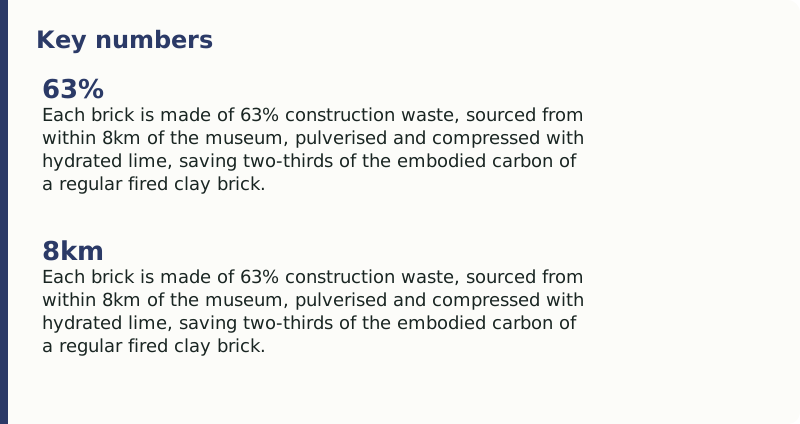
The project's centrepiece is a specially developed brick: each is made of 63% construction waste sourced within 8km of the museum, pulverised and compressed with hydrated lime, saving two-thirds of the embodied carbon of a regular fired clay brick (theguardian. com). The lime will keep absorbing CO2 from the atmosphere as it cures over coming months and years. The bricks were produced by East Sussex firm Local Works Studio and Brussels group BC Materials in a former railway depot nearby, with the public invited to press their own blocks during a two-day brick-making festival. The toilet cubicles feature tiles of seaweed, flax, wood terrazzo and volcanic ash, with QR codes for visitors. The €20m project was funded partly by Circular Flanders and Sogent, the city's development agency. [4] [5] [6] [7] [8] [9]
What remains unknown
The full scale of the building's lifetime CO2 absorption is not quantified in the report, and architect Sian Ricketts cautioned: "We're not claiming this is a panacea, or a solution to the climate crisis," describing it instead as a proof of concept. It is also unclear how the museum's visitor numbers or long-term environmental performance will be measured. Single source: theguardian. com — not independently corroborated. Source: https://www. theguardian. com/artanddesign/2026/oct/20/ghent-design-museum-co2-absorbing-recycling [10] [11]
Corrections
No corrections recorded for this edition.
Corrections policy